
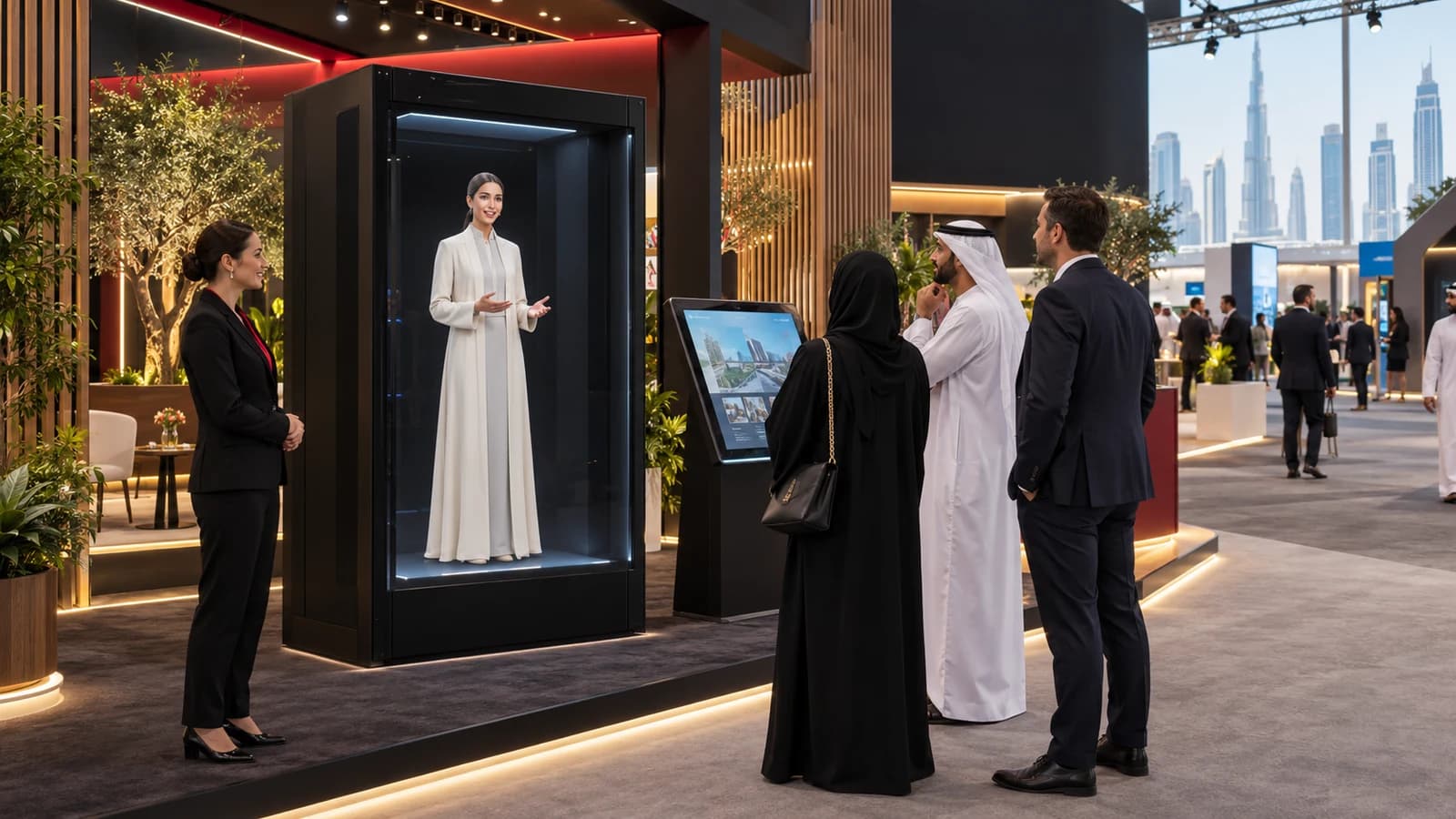
The difference between attracting attention and helping a visitor
An exhibition display has two jobs. First, it must earn a visitor's attention in a crowded hall. Second, it should help that visitor understand what the exhibitor offers.
A Holobox can create the first moment by presenting a person, product or character in a glass-free three-dimensional format. When the content is connected to a carefully designed AI avatar, the same installation can also answer questions, guide visitors through approved information and move an interested person toward the right human team member.
This does not make every Holobox an autonomous sales representative. The useful version is more disciplined: a visible digital host with a defined purpose, approved knowledge and clear limits.
What is an AI avatar for an exhibition?
An AI avatar is a digital presenter that combines a visual character with a conversational software layer. The avatar may speak from a prepared script, respond to selected questions or connect to a controlled workflow.
Inside a Holobox, the avatar has physical presence. Visitors do not need to look down at another tablet or scan a wall of text before they understand that the stand is interactive. The experience can be supported by a standing touchscreen, a microphone, on-screen choices or a member of staff who invites the visitor to begin.
- →The visual layer: avatar design, animation, voice, language and Holobox presentation
- →The knowledge layer: approved information and sources the avatar may use
- →The workflow layer: what happens after a question, selection or request
- →The human layer: when a member of staff should take over
Practical uses at a Dubai exhibition stand
An avatar can welcome visitors, introduce the company and explain the main sections of a stand or pavilion. It can present approved product information, visual demonstrations and frequently asked questions selected from a nearby touchscreen.
At international events in Dubai, the avatar can provide approved content in more than one language. Language support should be tested before the event, especially for brand names, technical terms and local pronunciations.
It can also explain a session schedule, identify the visitor's area of interest and, with clear consent, collect a small amount of relevant information before directing the visitor to the correct sales or technical representative.
A useful avatar knows when to hand the conversation to a person
Detailed commercial negotiations, unusual technical questions and sensitive requests should be handed to the appropriate person. The avatar can introduce the handover and provide context so the visitor does not need to repeat everything.
An exhibition avatar should not invent product claims, confirm an unavailable price, make contractual promises or present an uncertain answer as fact. It should not collect unnecessary personal information or continue a conversation when a human is clearly required.
These limits are part of the experience design, not a weakness. Visitors trust a system more when it is accurate about what it can and cannot do.
Plan the Holobox, touchscreen and stand as one experience
The front of the Holobox should remain visible from the main visitor approach. Bright lighting, direct reflections and busy printed graphics behind the display can reduce the clarity of the visual effect. A touchscreen should be positioned where a visitor can use it without blocking the viewing area or the main aisle.
The stand should include space for a small group because an effective avatar interaction often attracts other people who listen before deciding whether to participate.
Power, connectivity, microphone performance, speaker volume and event-floor noise must be tested together. A conversation that works perfectly in a quiet office may need different prompts and audio settings inside a live exhibition hall.
Prepare a narrow, approved knowledge set
The strongest starting point is a focused information set rather than unrestricted access to every company document. Answers should be short enough for a live environment and should offer the visitor the next useful choice.
Test questions phrased in different ways, unclear questions, off-topic requests and situations where the information is missing. The correct result is sometimes a polite human handover rather than an attempted answer.
- →Company and product descriptions
- →Event-specific offers and demonstrations
- →Approved technical specifications
- →Common visitor questions
- →Speaker schedules or pavilion information
- →Escalation contacts and handover rules
Measure whether the experience helped visitors
Footfall alone does not show whether the installation was useful. Depending on the project, teams can measure interactions started and completed, popular topics, languages used, questions requiring human help, demonstration requests and consented follow-up requests.
These signals can improve the content and staffing plan for the next event day. They should be collected in a way that respects the visitor and avoids unnecessary personal data.
Begin with the objective, not the technology
The question is not simply whether a holographic avatar will look impressive. The better question is what a visitor should be able to understand or accomplish after interacting with it.
For some stands, a high-quality non-interactive holographic sequence is the right answer. For others, an AI avatar can reduce repeated questions, support multilingual visitors and connect attention to a meaningful next step.
HOLO DXB combines Holobox rental, avatar and content preparation, installation and on-site technical support for events in Dubai and across the UAE. Interactive software and controlled AI workflows can be added when they genuinely improve the visitor journey.